General Principles
- Know the accessibility features and tools available in the parish and where to find them.
- Have a hospitality minister at the front door to assist and verbally welcome persons upon arrival.
- Ask, “Is there anything I can do to assist you?” Honor the response and follow the person’s lead. Don’t make decisions for persons with disabilities about what they can or can’t do.
- Not all disabilities are visible. If a person expresses a need, meet that need. Trust what they tell you is true.
- Treat persons with dignity and respect. Communicate directly to the person and use age-appropriate language and tone.
- Don’t assume a person can’t read or sing. If offering hymnals or bulletins, offer them to each person and if they decline accept their decision.
- If facilitating seating, ask the person where they prefer to sit in the worship space and if they need any accommodations such as visual aids, assistive listening devices, or receiving Communion at their seat.
- Take initiative to include parishioners in conversation and activities. There is nothing worse than being left out and ignored.
- If you are having trouble understanding a person, ask them to repeat themselves then restate what you heard. Do not nod like you understand if you do not. Do not interrupt and finish a person’s sentence.
- Rephrase, rather than repeat, sentences that a person doesn’t understand.
- Respect a person’s wishes if they decide to sit alone. Large groups or one on one conversations may be overwhelming for them.
- Ask questions aimed at understanding. If you observe behavior that you don’t understand, remain attentive in case the person needs assistance. Be nonjudgmental.
- Be patient. Speak slowly and wait for responses as language processing may be delayed.
Physical/Mobility
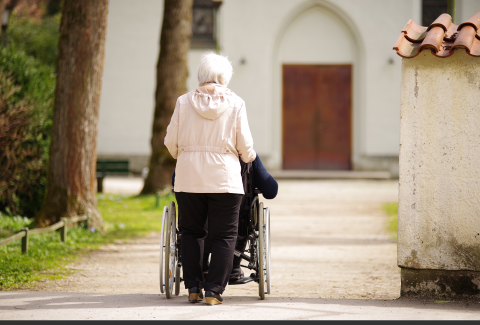
- Don’t push or touch a person, their wheelchair, or mobility device without first asking if they need assistance or if you can do so.
- Don’t rest or lean on a person’s wheelchair or mobility device.
Deafness/Hearing Loss
- Take the time to determine if the person prefers to use sign language, writing, gesturing, speaking, or a combination to communicate.
- To get the attention of a person who is Deaf or has hearing loss you can tap them on their shoulder, wave your hand, or flicker the lights.
- Do not speak loudly to a person who is wearing a hearing aid. Your raised volume will be more distorted and may bring unnecessary attention to them.
- Face the person directly when speaking and do not obscure your mouth when communicating.
- When using a sign language interpreter, look directly at the person who is Deaf and maintain eye contact. Speak directly to the person who is Deaf rather than directing your comments to the interpreter.
- Eliminate as much background noise as possible (vents, static, etc.)
Blindness/Partially Sighted
- Identify yourself and your role (I am the greeter/usher).
- Ask "Would you like assistance?" If so, offer your arm. Describe the environment after asking how they prefer you do so (e.g., using words like “at 3 o’clock” or “about 5 yards to the left”).
- Do not walk beside a guide dog. Walk on the other side of the handler, a few steps behind them.
- Do not touch a person’s cane or guide dog.
- Give verbal cues that are specific (e.g., don’t say "watch out", say "there is a trash can in front of you..." or “there is a step down” ahead).
- Guide a person’s hand to a banister or the back of a chair to help direct them to a stairway or seat.
- Inform an active parishioner who is blind about any physical changes in the environment (e.g., the creche is set up on the far left wall and extends three feet from the wall).
- Offer large-print (24-font) or brailed bulletins, prayer books, and hymnals. The Xavier Society for the Blind is a good resource for these materials.
-
Establish before Mass if a person would like accommodations for Communion (e.g., Eucharistic Minister to come to them, sighted guide).

Related Disability or Ministry:
Resource Type:
Language of resource: